|
|
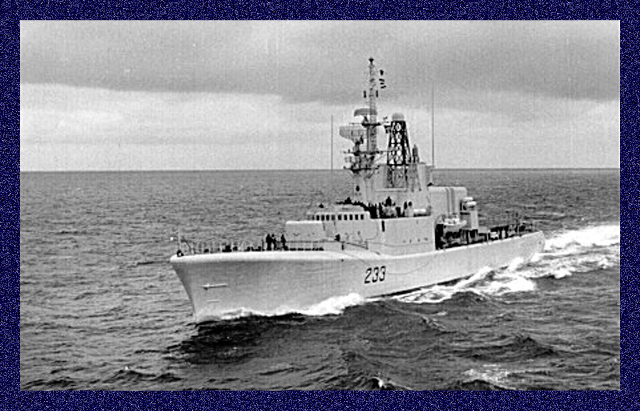
Fraser & IMy blurb for James Bay explains how I got my dream appointment (as an Acting Sub Lieutenant) to Fraser , and then didn't want it. This blurb explains the Who responsible for the first part, and my Why for the last. The man was her captain, Raymond Phillips, designated "Pusser Ray" for his alleged habit of having freshly laundered starched collars flown out to him during the Battle of the Atlantic. He also showed a yard of French cuff, and as much handkerchief. He had been Second in Command at my naval college, HMCS Venture , and taken me salmon fishing -- expressing something less than pleasure when a cadet (me) caught a bigger fish than a commander (him). In his welcoming address to the first year intake at Venture he imparted three pieces of advice: never eat in a greasy spoon; in banks, always ask to speak to the manager; and learn to say "My friend will pay" in as many languages as possible. In spite of this, he was admired to the point of hero worship by me and most of the RCN at that time, as the man most likely to become a Chief of Naval Staff. (That he did not, is another bitter episode in the small tragedy called Unification: mentioned in The Sea & I .) When he personally requested that Naval Headquarters appoint me to his ship I should have been overjoyed. Fraser was brand new, and still looks modern today. Her crew had been handpicked by Phillips, to the point that other ships complained. His credo was to be the best ship in the Pacific Fleet, and not look as though she was working to do it. He asked for me, and three other Midshipmen, because he did not believe we should be in minesweepers - which would have been fair enough, except that in James Bay I had been treated as an equal in the wardroom. Aboard Fraser, it was a case of being sent back to Ontario 's Nelsonian gunroom. The most draconian change was that I could not sleep -- that is, stay overnight -- ashore, at the age of 21. In order to do that I decided to get married. To do that, in an action I still find astounding, I actually asked my Captain's permission. Of course he gave it, and escorted my bride with a Guard of Honour, and signed the Watchkeeping Certificate which allowed me to fulfill my true dream, of driving destroyers. He also nearly got me killed. Some months before my marriage our Squadron of Destroyers was visiting Viet Nam. (As an historic aside, the number of Canadian sailors aboard our ships exceeded the number of foreign troops allowed by the Geneva Treaty that divided North and South.) We had just entered the Saigon River when Pusser Ray got the bright idea of re-enacting a gunboat scene from Horatio Hornblower: "Showing the Flag". He ordered a ship's boat to be put over the side, with an armed crew, and someone in charge. "Young David," he said, nodding at me in his most casual, hanky flapping mode. The boat got lowered to the waterline before the Squadron Commander, Mickey Stirling, asked what the hell was going on!? The Hornblower expedition was aborted. The two halves of Viet Nam were already shooting each other from opposite sides of the river. In a coda to this section: in 1980 I was in New York to see my editor at Viking about A Woman Called Scylla , and had an afternoon to kill. I used the time to see Apocalypse Now. The theatre was empty except for me. As Bob Duvall (another Argentine Tango nut) stormed ashore with his surfboard, I thought of that moment when I was hanging from Fraser's davits. Ray's "Showing the Flag" to the Viet Cong was suitably crazy that it could have been included in Coppola's film. P.S. About the Squadron Commander, Mickey Stirling. In history's eyes, he can be seen as one of the Canadian Admirals with sufficient gumption to resign over Unification. For me, it's enough that I have, in my Midshipman's Journal, beside a drawing of a sampan, this notation by his hand: "Good writing, but indifferent sketches." |
|
|