Word Processors & I
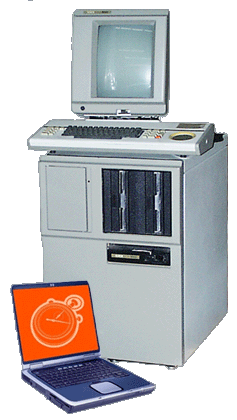
The Xerox 850 dedicated word processor entered my life in 1982 at a cost of $14,000 and brought with it two contentious items: an annual maintenance fee (paid quarterly) of a further $1500, and the annoying question, "Doesn't it change your writing?" -- meaning, for the worse -- from countless snobs and other writers, not necessarily in that order.
This hidden corner of the universe is my virtual response.
|
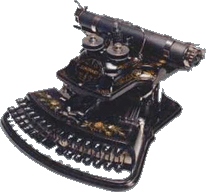
The argument about writing implement affecting writing (adversely) has raged at least since Homer, and probably since the creators painting bison in the Lascaux caves. It became recorded when Dr Johnson derided those who declaimed the malign properties of the Fountain Pen to denizens of London's coffee houses: The Quill alone was Pure. To which the Good Doctor responded, with expletives deleted, "Pure bull****!" -- or, that it was what was in the ****ing brain, not the ****ing pen, that counted. Invention of the Typewriter was equally and immediately condemned -- except for the minor talent of Mark Twain who bought the first one off the line and declared it a Godsend for the rest of his life. |
|


The 850 only stayed in mine for a decade -- by which time it had cost another $15k, and was worth every penny because it freed me from driving across town once-daily to take pages of Troika to a secretary whose dwelling almost burned down before she kept a carbon copy -- but I digress.
There is one central truth about any writing implement: there shouldn't be one.
In a perfect writing world nothing would come between the thought arriving in the writer's head, and its appearance as words on paper. Until that centrally-wired Nirvana occurs, an electronic word processor is the next best thing -- and the Xerox 850 was "very best" indeed: years ahead of its time, and then kicked out by its owners in a monumental corporate blunder (for which I suggest you read any virtual history of Xerox Parc).
The central fact about electronic word processors is that the brain thinks the screen is a picture, not a sheet of paper. For that reason I do (nearly) all my editing on printouts, with a (felt) pen, and then enter them into the machine. Others may -- and indeed, will -- do as they wish. People love a good myth.
|
I loved my Xerox 850, despite its having the size and weight of a washing machine. It also had the first primitive mouse -- the circular flat membrane in the picture -- which, if you traced a thumb on it, heavily, made a cursor crawl like a beetle across the screen. (Then it served no useful purpose. Today, the wheel has turned full circle and most laptops use the principle.) There was also, in a computer world of 14 inch monitors, a vertical screen which could show a full book-page of text, an absolute essential for a novelist. A printer, with a tractor feed, was a monster -- but the 850, unlike Microsoft, could actually both think and print! And because all its instructions were hardwired in the washing machine part, it was extremely fast. (For history buffs, the following Xerox 860, which loaded its program on mammoth 8 inch floppy discs, was actually slower than the 850.) |
|


As well as these hardware breakthroughs, the architecture of the Xerox word processor programming was superb: when I was finally forced to switch to the Microsoft world of Word 2, I couldn't believe how bad it was, and spent a year and a half with a programmer in Ottawa, Luke Smith, devising a program which synthesised the two, and which I still use.
On the day when a moving van and three men arrived to take my 850 to its final resting place, I asked them to hold off while I grabbed a laptop and camera to record for posterity the astonishing advances in computer technology. When I came to create this site - I couldn't find the picture. Nor, on the web, could I find any visual trace of the Xerox 850. It seemed as though Xerox wished all memory of their misadventure with Parc at Palo Alto to vanish from the earth.
In desperation I sent a message to the person foolish enough to have taken the massive 850 off my hands. To my slight relief he still had it. To my mounting surprise and gratitude, Randall Brooks, Curator at the Canada Museum of Science and Technology, in Ottawa, went to his warehouse and produced the image you see above.